





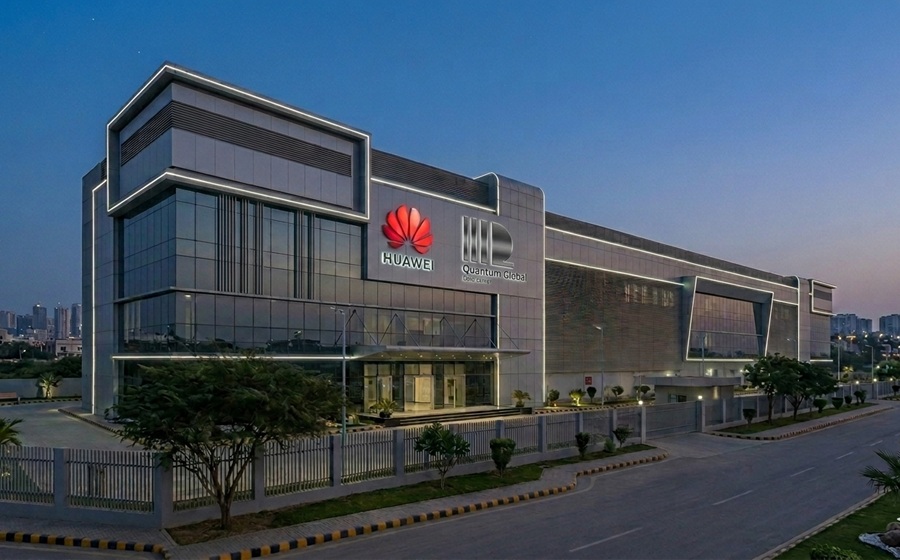
Quantum Global Data Center (QGDC), a venture of the Gul Ahmed Energy Group, has announced a $230 million investment to build Pakistan’s largest data center. The Tier III facility, located in Karachi, is expected to become operational by 2027, with total investment potentially reaching $600 million over the next three to four years.
The announcement was made at the Q Summit in Karachi, where QGDC and Huawei Pakistan signed a formal strategic partnership agreement to co-develop the project.
Alongside the data center, the two companies plan to build a science and technology park as part of a broader effort to establish Karachi as a hub for Pakistan’s digital infrastructure. The initiative targets cloud computing, AI workloads, digital finance, and e-government services.
Why Pakistan Needs its Own Largest Data Center Now
QGDC Chairman Danish Iqbal used the Q Summit to frame the announcement as a matter of economic urgency. Pakistan already spends between $700 million and $800 million annually on AI-related computing and the country, he argued, has barely begun its AI adoption curve.
“Right now, with this minimal AI, we haven’t even started. For our economies to grow, we need to go to very high AI compute. And that compute, without data centers, we will not be able to do.”— Danish Iqbal, QGDC Chairman
Iqbal warned that without domestic data center infrastructure, Pakistan risks spending billions importing computing capacity from abroad – a dependency he said the country could not afford long-term.
“We are at that stage that if we don’t take this chance right now, we will miss this boat. And this will be a very costly boat, which we will not be able to build,” he added.
He pointed to hospitals, schools, financial institutions, and government agencies as the main drivers of growing demand for cloud capacity – all sectors actively migrating toward digital-first operations.
Key takeaways
- QGDC announced Pakistan’s largest Tier III data center at the Q Summit in Karachi.
- Huawei Pakistan signed a formal strategic partnership to co-develop the facility alongside a science and technology park.
- Pakistan currently spends $700-$800 million annually on AI computing, with demand expected to surge in coming years.
- The data center will support cloud, AI, high-performance computing, digital finance, and e-government workloads.
- Sindh government has pledged full support, tying the project to the Karachi Technopolis initiative.

What Pakistan’s Largest Tier III Data Center Will Support
The QGDC facility is classified as Tier III, which is the same standard used by major banks and telecoms worldwide, offering high fault tolerance and guaranteed uptime. It is designed to handle cloud computing, AI inference and training, high-performance computing (HPC), digital finance platforms, and e-government applications.
A central goal of the project is strengthening data sovereignty, ensuring that Pakistani data is stored and processed on Pakistani servers, under Pakistani law. As data privacy regulations tighten globally, this has become a strategic priority for both the government and enterprise clients.
The partnership agreement was signed by QGDC’s Chief Operating Officer Ubaid Amanullah and Huawei Pakistan CEO AI & Cloud Business Ahmed Bilal Masud.
“Pakistan stands at the threshold of a new digital era, and this partnership reflects our belief that AI innovation requires strong digital foundations. When modern data centers, high-performance computing, secure cloud platforms, and trusted digital infrastructure come together, they unlock new opportunities for businesses, governments, and society,” Masud said.
Huawei’s Role in Data Center Project
Huawei Pakistan’s involvement goes beyond construction. Under a Memorandum of Understanding signed last month, Huawei is providing data center design, technical planning, and specialized infrastructure solutions aligned with international standards. The company’s Huawei Cloud already serves customers in more than 170 countries.
A key element of Huawei’s offering is Huawei Cloud Stack, a sovereign cloud solution that allows governments, banks, and telecoms to run cloud infrastructure while retaining full control over their data, security protocols, and compliance requirements. That combination of sovereignty and scale is central to how QGDC and Huawei are positioning the facility for enterprise and public-sector clients.
Government Backing and Karachi Technopolis Link
Pakistan’s provincial Sindh government formalized its support at the summit. Ali Rashid, Sindh’s Minister for Science and Information Technology, reaffirmed the provincial government’s full commitment to the QGDC data center project and its connection to the Karachi Technopolis, a broader initiative to establish Karachi as Pakistan’s anchor city for digital infrastructure.
“The future is built on data and IT,” Rashid said, pledging government support to drive the vision forward. That political alignment matters: large-scale infrastructure projects in Pakistan have historically faced delays tied to regulatory approvals and land acquisition. Government backing from the outset reduces that friction considerably.

Economic Case for Pakistan’s Digital Infrastructure Push
Speakers at the Q Summit argued that data center investment carries an economic multiplier that extends well beyond the facility itself. Cloud access lowers the barrier to entry for startups, AI tools raise productivity across industries, and robust digital infrastructure makes a country more attractive for foreign technology investment.
Pakistan ranks among the world’s largest freelance tech markets by headcount, yet much of the infrastructure underpinning that workforce currently sits on servers outside the country. Pakistan’s largest data center, if the QGDC project hits its 2027 target, would begin to change that equation and would represent the single largest private investment in the country’s digital infrastructure to date.


