



Global electric vehicle (EV) sales topped 20 million in 2025, marking a 20% increase from the previous year and meaning one in every four new cars sold worldwide was electric, according to the International Energy Agency’s (IEA) Global EV Outlook 2026.
The IEA expects global electric car sales to rise further to 23 million in 2026, equal to about 28% of total new car sales, driven by stronger demand in Europe, continued expansion in emerging markets, and improving cost competitiveness of electric vehicles.
In 2025, global EV sales extending a multi-year growth streak and reinforcing the rapid structural shift in global car markets despite uneven policy and economic conditions.
Chinese automakers supplied 60% of global electric car sales in 2025, while European and North American automakers were each responsible for about 15% of global sales, according to the IEA report.
China leads, Europe accelerates, US stalls
China remained the dominant EV market, with electric cars accounted for nearly 55% of new car sales in China. The country still represented the majority of global demand, supported by trade-in schemes and a large domestic manufacturing base, although growth slowed slightly compared with earlier years.
Europe recorded the strongest growth among major markets, with EV sales rising more than 30% to reach 28% of total car sales, driven by stricter EU CO₂ standards and a wave of more affordable model launches.
In contrast, the United States remained relatively flat at just under 10% of new car sales, with momentum weakening toward the end of 2025 following the phase-out of federal EV tax credits and related policy changes.
Emerging markets emerge as new growth engine
Outside the three largest markets, EV adoption accelerated sharply.
- Southeast Asia saw sales more than double, reaching nearly 20% of new car sales, led by Viet Nam, Thailand, and Indonesia
- Latin America grew by 75%, driven by Brazil and Mexico
- More than 100 countries recorded EV sales growth in 2025
- In one-third of countries, EVs already made up at least 10% of new car sales
The expansion was largely driven by cheaper imported models, especially from China, which now account for around 60% of global EV supply and an even higher share in several emerging markets.
Tesla, BYD and rising challengers reshaping the EV transition
The global EV market in 2025 continued to be defined by intensifying competition among a small group of leading automakers, with Chinese manufacturers extending their global advantage.
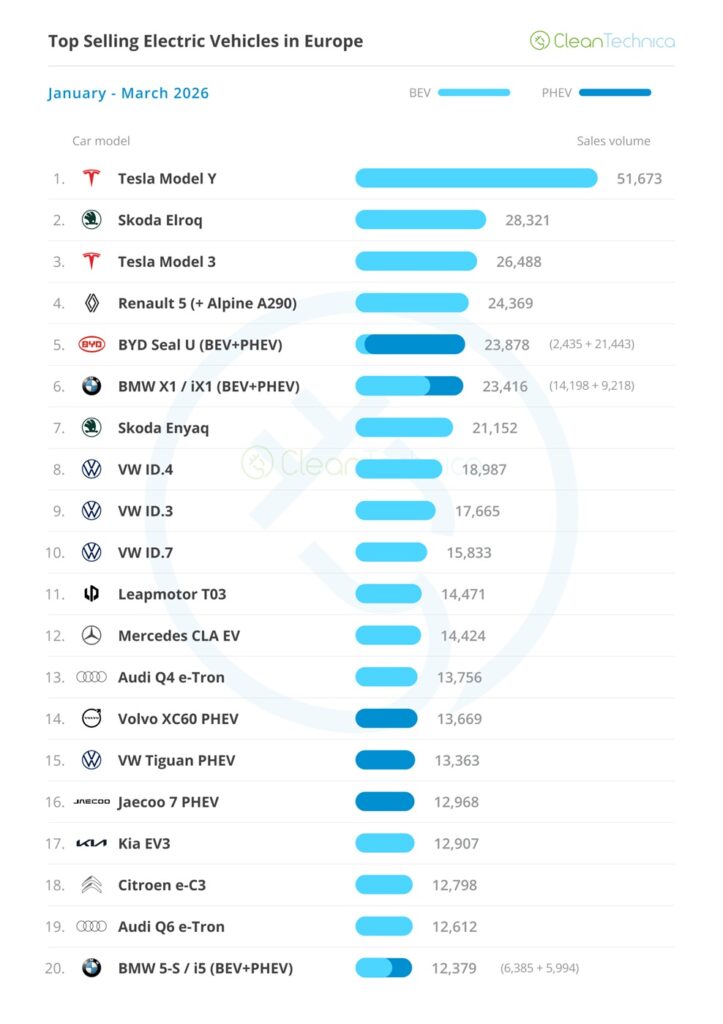
BYD strengthened its position as one of the world’s leading EV makers by sales, expanding rapidly in both domestic and overseas markets and continuing to scale exports across Europe and emerging economies. Tesla remained one of the most influential EV makers globally, anchored by strong Model Y and Model 3 volumes, but faced increasing pressure from a wider range of competitors and a more crowded mid-price segment.
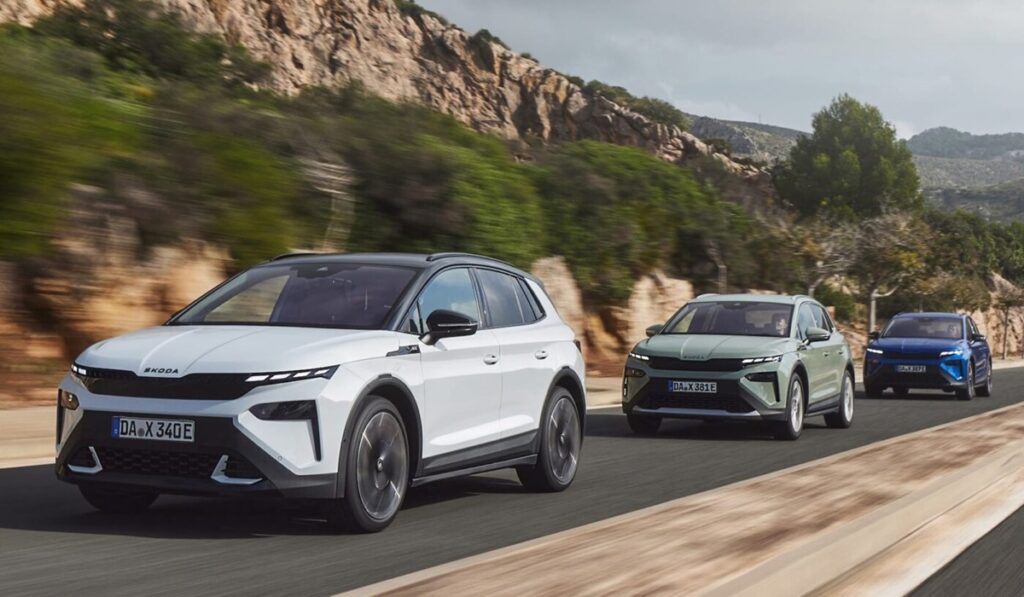
European legacy manufacturers made notable gains. Volkswagen Group increased its EV sales share across Europe, helped by the expansion of its ID lineup and stronger fleet demand. Within its brand portfolio, Škoda Auto emerged as one of the group’s standout performers, with models such as the Skoda Elroq contributing to its expansion in the fast-growing compact SUV segment.
Alongside incumbents, newer entrants and Chinese brands continued to reshape the market structure, with Geely, SAIC and other Chinese automakers consolidating their global reach through competitive pricing and rapid product cycles. Industry rankings of innovation in electric mobility increasingly place Chinese groups and Volkswagen among the leaders, reflecting a convergence between traditional automakers and EV-first manufacturers.
Energy crisis reshapes transport priorities
The IEA highlights that the ongoing energy crisis linked to geopolitical tensions has renewed global focus on oil dependence, particularly in transport, which accounts for nearly half of global oil demand.
Electric vehicles already avoided around 1.7 million barrels of oil per day in 2025, with China and Europe accounting for most of the displacement due to strong policy frameworks.
The agency notes that EV uptake is increasingly being viewed through the lens of energy security, especially in oil-importing economies, where governments are beginning to strengthen incentives in response to high fuel prices.
Prices fall, but affordability gaps remain
Electric vehicle prices continued to decline in major markets in 2025:
- China: ~10% price decline
- Germany: ~6% decline
- United States: ~2% decline
Falling battery costs and increased competition helped improve affordability, particularly in China where around 70% of EVs are now cheaper than comparable combustion engine vehicles.
However, affordability remains uneven globally. In Europe and the US, limited availability of low-cost models continues to slow adoption despite improving model variety.
Model expansion, but sales remain concentrated
Around 630 battery electric vehicle models were available globally in 2025. Yet sales remain highly concentrated across a small group of best-selling models:
- Just five models accounted for ~20% of global BEV sales
- Tesla Model Y alone represented nearly 8% of global EV sales
- Chinese manufacturers accounted for more than half of global EV sales
SUVs account for around 70% of global electric car sales in 2025, particularly in key markets such as the United States.
Policy support rising in total, declining per vehicle
Global government support for EVs reached about $60 billion in 2025, even as per-vehicle subsidies continued to decline.
- Government spending in China accounted for nearly 60% of the global total in 2025
- Europe saw rising fiscal costs due to higher EV sales, despite mixed subsidy phase-outs and renewed support schemes in some countries
- The US phased out most federal EV support after 2025 tax credit expirations
- Emerging markets rely mainly on tax exemptions and import duty relief rather than direct subsidies
Overall, support per vehicle has fallen significantly over the past decade, even as total spending rises due to growing EV adoption.
EV outlook: 23 million sales expected in 2026
Looking ahead, the IEA expects global EV sales to rise to around 23 million in 2026, representing approximately 28% of total car sales.
Growth is expected to be:
- Europe: ~20% increase, reaching one in three new cars sold
- China: continued expansion toward nearly 60% EV share, but at a slower growth rate
- Asia Pacific (excluding China): over 50% growth
- Latin America: about 45% growth
EVs could make up around 50% of global car sales by 2035 in IEA exploratory scenarios, with China exceeding 90% EV sales share and Europe following a similar path.
The report concludes that EV growth is being driven by a combination of structural cost declines, tightening emissions regulations, and rising energy security concerns – factors that are increasingly reshaping the global automotive industry.