





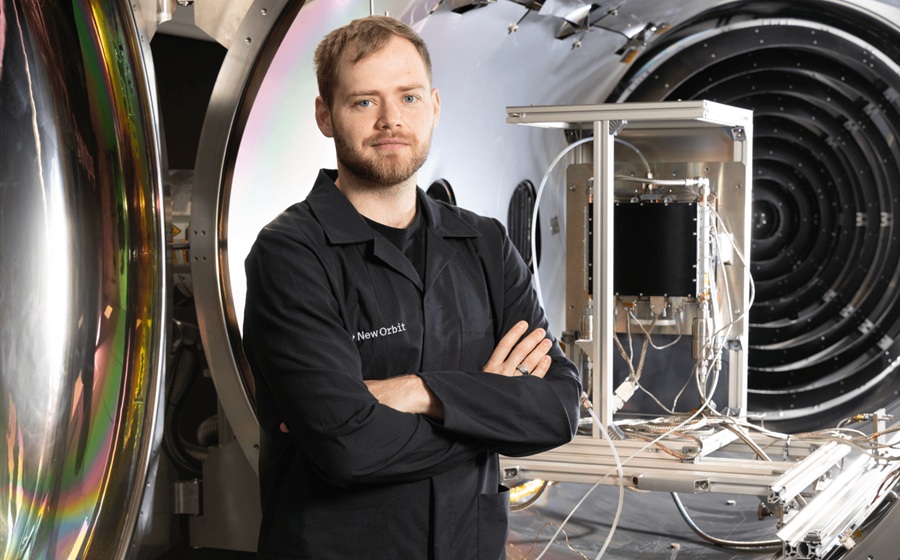
Commercial aircraft cruise at around 10 kilometers. Conventional satellites orbit above 500. Between them lies very low Earth orbit – and for sixty years, no commercial satellite has operated there. UK-based startup NewOrbit wants to change that.
On June 8, the company announced an oversubscribed $18.5 million (€16 million) Series A to fly the world’s first commercial payload at 200 to 300 kilometers. The company plans to use the funding to execute its first mission in 2028, sign commercial customers, and open a satellite production facility in 2027.
Key Highlights
- $18.5M Series A led by Voyager Ventures, oversubscribed, with angels including former Nvidia chief scientist David Kirk and TIER Mobility co-founder Lawrence Leuschner
- First commercial VLEO launch in 2028 will be the first time customer payloads will fly at 200–300 km altitude
- 20x cheaper satellite imagery than conventional satellites, with faster data speeds
- NEO Production Complex opening 2027, scaling from 10 satellites per year to several per week
- Founded in 2021 by CEO Anatolii Papulov and CTO Ruslan Rakhimov, formerly of Moscow-based Avant Space Systems.
Problem Nobody Solved
Very low Earth orbit isn’t just a different altitude. It’s a different engineering category entirely.
Atmospheric drag alone would pull an unprepared satellite back to Earth within weeks. Add atomic oxygen eroding external surfaces and aerodynamic torque destabilizing orientation, and it becomes clear why no commercial operator has attempted it. “You actually have to build entirely new satellites to fly at this altitude,” said CEO Anatolii Papulov. “Almost every subsystem is different.”
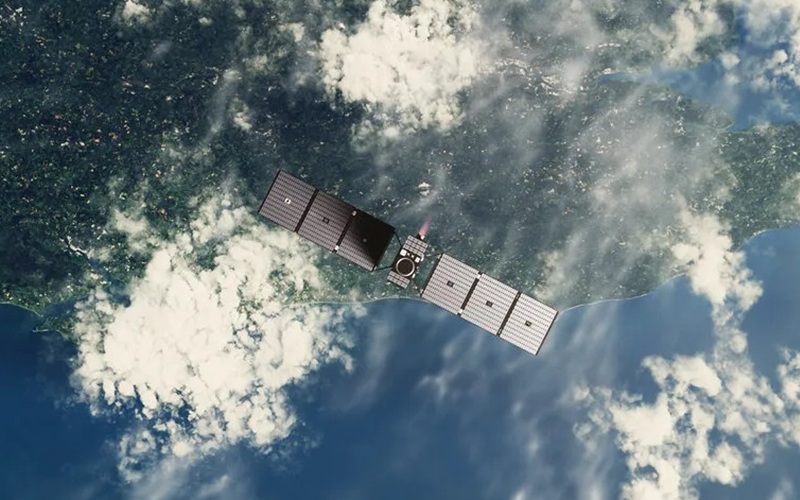
NewOrbit’s answer is NEO-1 – a purpose-built satellite with proprietary electronics, thermal, structural, and control systems, embedded software, and an air-breathing electric propulsion system based on gridded ion thrusters. The company claims it can operate reliably at VLEO for up to five years. Its engineering team includes veterans from SpaceX, NASA JPL, RocketLab, Tesla, Airbus, ESA, and Formula 1.
Why the Altitude Matters
Lower orbit means sharper imagery, stronger signals, and faster data — at a fraction of the cost. NewOrbit says it will deliver drone-quality imagery from orbit at 20 times lower cost than conventional satellites. Applications that are not possible from higher altitudes also become viable: 5G connectivity direct to an ordinary phone with no special antennas, LiDAR from space, and live HD video.
“For sixty years, VLEO has been treated as too hostile an environment for commercial satellites – but it is in fact the most valuable empty real estate in space,” Papulov said. “Today, no one in the industry has a reliable, affordable and fast way to fly payloads in very-low Earth orbit. We built our NEO-1 satellite to do exactly that.”
The company is positioning itself as a platform. “We are building this as a product for anyone to come to us and say, ‘We want to fly at VLEO, bring us there,'” Papulov told SpaceNews. “We will integrate it and fly there.”
Funding Round
Voyager Ventures, which manages $475 million across three funds, led the Series A. David Kirk, former Nvidia chief scientist, and Lawrence Leuschner, co-founder and former CEO of TIER Mobility, joined as angels alongside Custos Family Office. Atlantic VC, Lifeline Ventures, LGF, and Illusian returned from prior rounds.
“VLEO is the next foundational shift in the global space industry,” said Voyager partner Matthew Blain. “The technology will unlock order of magnitude improvements in earth observation at a fraction of the cost today.”
Building the Factory
The NEO Production Complex opens in 2027, starting at 10 satellites per year and ramping to several per week. NewOrbit’s goal is to make it Europe’s largest dedicated VLEO production facility.
Alongside the funding, NewOrbit announced that Jean-Jacques Dordain, former ESA Director General (2003–2015), is joining its advisory board. He joins Sir Chris Deverell, former Commander of UK Joint Forces.
“VLEO is one of the few genuinely new commercial categories remaining in space, and opening it requires a rare combination of engineering excellence and institutional discipline. NewOrbit has both, and the fact that this category is being defined from the UK is significant for European space,” Dordain said.
Deverell said he believes “VLEO will become a critical layer of future space infrastructure, supporting both commercial and national security missions,” adding: “I’m proud that this capability is being built in the UK, helping to establish Britain as a leader in next-generation space technology.”


